

Platform & Architecture – Page 4
Core dna was launched in 2015, but our team was operating as a digital agency since the year 2000, building, tweaking and using Core dna for our clients as we grew.
Thanks to Core dna’s decoupled nature, paired with our microservice architecture, our DXP is ready for anything. If your content is managed by Core dna, you’ll always be able to deliver it to any new device that emerges on the market.
Yes. Core dna can build intranets and social communities for professionals that enhance communication and collaboration.
See Core dna’s digital workplace features.
There are a number of differences between Monolithic systems and a Headless system, these include:
- Monolithic systems have lots of functionality built into them that not all customers need.
- A headless platform gives you access to entities, examples of these are pages, menus, products, blogs, people, etc. Entities are the base objects that you can then modify and enhance to your requirements.
- Monolithic systems are more focused on delivering solutions to the end client rather than the developer. Core dna’s platform strikes a balance between the developer environment and the admin environment.
- Headless platforms in many cases don’t come with admin tools for end clients. Core dna continues to provide admin friendly tools inside our headless platform.
- Access to information from a monolithic system can be difficult.
- Monolithic systems require you to establish the infrastructure and the security tools to make them work.
- Monolithic systems can take time to learn and understand the way they work.
- Headless platforms allow you to create your own publishing environments.
Read this next: Headless CMS vs Decoupled CMS: The Ultimate Guide
The easiest way to determine if a headless platform is best for you is to ask yourself these questions:
- What are your business requirements and does a headless platform solve these requirements?
- Do you have access to qualified individuals to help with the setup and ongoing management of the platform?
- Can you determine the content types that you will require (e.g. buttons, headers, lists, options, etc.)?
- Do you want to design your own components using the content types you can define? You can always add components later but planning up front will help with organizing your content for distribution.
- Determine if you want to enrich your content with templates and styling to create consistent output and not just data.
- Do you want to test the output from the headless platform using tools that allow you to make API calls?
- Do you want to configure the destination systems to accept the information?
In the case of Core dna, we provide an admin panel to help with the creation of the content and preview of the content. We also give you a number of tools for security and personalization. Finally, we have defined a number of entities that give you the starting point for your project to help with quick deployment.
Core dna is a decoupled platform, meaning we have headless content management built-in, but we also give you the front-end tools you need to present your content to your end-user.
This depends on the traditional platform. With a headless CMS, the key difference is its ability to create different content types and then make that content available through an application programming interface (API).
If a traditional CMS is able to process API requests it can be integrated with a headless platform. If it's not then programmers will need to process the API requests outside of the traditional CMS, through the use of javascript in the display of the website.
There are a number of differences between headless and decoupled platforms; these include:
- Flexible content models that allow you to describe your data in the headless platforms.
- Advanced APIs that can use query languages for APIs like GraphQL.
- Headless platforms are designed to deliver content quickly and efficiently without any overhead.
- Decoupled platforms are generally connected to a display layer templating language for building user interfaces.
- Headless platforms may not have any display of layer templating. Hybrid platforms like Core dna do still offer templating languages and admin interfaces for the convenience of admins.
- A high degree of customization & flexibility for developers in the headless platform.
Pros
- Flexible developer environment to create and manage content across multiple channels
- Ability to create and deploy tailored customer experiences quickly
- Ability to learn, change and iterate direction quickly
- Share content programmatically with other systems
- Create workflows and recurring processes that communicate with the platform and other systems
- Advanced security provided by simple interactions through APIs
- Improved performance, ability to create static content and have websites that are fast
- Scale, ability to handle peaks and large volumes of website content from a single source
Cons
To stay ahead of the curve in the fast-changing digital landscape, companies must have content management systems that are quick to adapt and scale efficiently. A headless platform separates your content backend from the frontend presentation layer opening up myriad possibilities for organizations’ digital experiences. This below we explain how adopting a headless architecture can change your digital business.
What is the technical architecture & integration
Microservices-Based Foundation
Headless platforms rely on microservices to provide higher speed and flexibility. They break down functionality into independent services that are then combined to create a complete solution. Organizations can scale specific components as needed without affecting the entire system. For instance, during peak sales periods, an e-commerce company may increase its product catalog service while maintaining normal capacity for its blog content service.
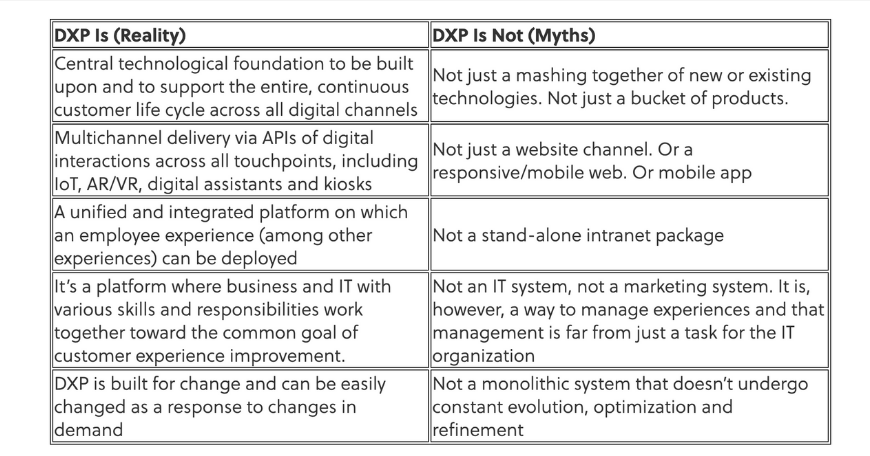
A DXP or Digital experience platform is a central technogical foundation to be built upon and to support the entire, continuous customer life cycle across all digital channels.
- From one platform, one login, brands and business can manage content, assets, and interactions across multiple different channels.
- It allows multichannel delivery via APIs of digital interactions across all touchpoints, including Iot, AR/VR, digital assistants and kiosks.
- It helps efficiently and effectively create, store, publish and optimize content for any channel – whether it’s a website,
mobile app, or social media page. - It's a platform where business and IT with various skills and responsibilities work together towards the common goal of customer experience improvement.
- It helps tracks user behavior on your websites, monitor key performance indicators (KPIs) in real time.
- It integrates with your tech stack for increased personalization and engagement with customers, and gather
customer insights from data analytics. - Here is how claude ai thinks of the Core dna DXP platform
Unlike a traditional CMS/eCommerce, which combines content management and front-end delivery, a headless platform has a flexible front-end system to determine how the content is created and presented to the end user. It’s front-end agnostic, meaning that your content is created raw and can be published anywhere, through any framework, thanks to built-in APIs.
Coredna is not only a headless platform but also a hybrid headless Platform. We recognized that Marketers still need the flexibility of an easy to use administration, so we created a fully functioning DXP administration panel that allows the marketer to have a dashboard and the ability to manage multiple websites. With the Headless features of the Core dna DXP you can also create a customized publishing platform, this can be useful if you want to simplify administration functions or create a custom user experience.
Standard plans do not require any fixed contracts. There is a simple agreement that covers the use of the software and the content you may produce. For our enterprise clients, we do sign contracts to cover custom setup, extended SLAs and ongoing support.
A platform that balances marketing and IT needs.
A Digital experience platform or DXP allows brands to deliver personalized content based on customer's digital footprint.
Core dna is a single platform with its applications built in, not a core product you extend with third-party add-ons. Every plan includes every application, so what you can build is not gated by which modules you bought.
The main application groups: