
B2B eCommerce: The Complete Guide to Strategy, Platforms & Growth
B2B businesses are run differently from B2C ones, and for the longest time it was all relationship- and phone-based.
Today, with B2B eCommerce platforms offering tailored solutions, more and more businesses are moving toward a digital approach—expanding their reach and driving new sales well beyond their existing network.
Yet going digital in B2B is not as straightforward as launching an out-of-the-box B2C store. Features such as bulk ordering, custom pricing, and intricate approval workflows simply aren't part of a standard B2C platform, which is why specialized B2B eCommerce platforms exist. And the platform is only half the story—pricing strategy, catalog quality, the customer journey, and the metrics you track all determine whether the channel actually grows.
This is the complete guide to B2B eCommerce. We'll start with the fundamentals (what it is and how it differs from B2C), weigh the benefits and challenges, walk through how to evaluate and choose a B2B eCommerce platform, show how Core dna approaches B2B, and finish with how to measure and grow the channel. Wherever a topic deserves a deeper dive, we link to a focused guide.
What You'll Find in This Guide
This page is the hub for everything B2B eCommerce. For more detailed guides:
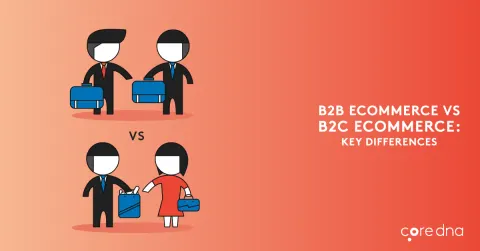
- B2B vs. B2C eCommerce: how the models differ and why it changes your platform choice. Start with B2B vs. B2C eCommerce and B2B personalization vs. B2C.
- Benefits and challenges: the honest case for going digital. See the pros and cons of B2B eCommerce and why B2B eCommerce is more challenging than you think.
- By business type: the playbook isn't the same for everyone: manufacturers, distributors, and wholesalers.
- Pricing and operations: where deals are won or lost: B2B pricing strategies, the B2B pricing engine, product catalog mistakes, and B2B portals.
- Measuring success: prove and grow the channel: B2B eCommerce KPIs, B2B eCommerce ROI, and the B2B customer journey.
What Is B2B eCommerce (and How It Differs from B2C)
B2B eCommerce is the buying and selling of goods or services between businesses through an online channel, manufacturers selling to distributors, distributors selling to retailers, wholesalers selling to trade accounts, and everything in between. On the surface it looks like B2C: a catalog, a cart, a checkout. Underneath, the rules are completely different.
In B2C, almost every buyer sees the same product, the same price, the same tax rule, and the same payment options. In B2B, a single account might have negotiated contract pricing, a custom catalog, a multi-step approval chain, net payment terms, and a procurement system that needs to talk to yours. Orders are larger, less frequent, and often recurring. The “buyer” is frequently a team, not a person.
Those differences cascade into everything: pricing, content, fulfillment, and the buying experience itself. For a side-by-side breakdown, read our full comparison of B2C eCommerce vs. B2B eCommerce. And because personalization works very differently when you're selling to accounts rather than individuals, it's worth understanding how B2B personalization differs from B2C.
The Benefits and Challenges of B2B eCommerce
Done well, a B2B eCommerce channel expands your reach beyond your sales team's network, lets your best accounts self-serve their routine reorders, reduces manual order entry, and gives you data you never had when everything happened over the phone. It can lift average order value, shorten sales cycles, and free your reps to focus on high-value selling instead of order-taking. We cover the full upside—and the trade-offs—in the truth about B2B eCommerce: pros and cons.
It's also genuinely harder than B2C. Complex pricing, account hierarchies, ERP dependencies, and long buying cycles mean a retrofitted consumer platform tends to break under real B2B conditions. If you want a clear-eyed view before you invest, read why B2B eCommerce is more challenging than you think. Understanding the challenges up front is exactly what helps you choose a platform that can actually carry them.
Understand What Makes B2B eCommerce Different
If you're running a B2B business, you've probably seen how messy things get when your platform isn't built for the way you actually work.
When it comes to bulk orders, account approvals, or pricing that changes by customer, most platforms don't handle those out of the box. That's why, before you even start comparing platforms, you should ask yourself: can this platform match how we operate, or are we going to have to change the way we work to fit the tech?
A good B2B eCommerce platform should be flexible from the start. It should handle your unique workflows, your customer hierarchies, and your custom pricing rules without turning everything into a dev project. These are some of the B2B eCommerce features we consider non-negotiable:
- Bulk orders and tiered pricing: B2B transactions often involve large quantities, negotiated rates, and dynamic pricing based on contract terms or order volume.
- Account hierarchies: Control who can access what. The platform should support different permissions for managers, retailers, approvers, and finance teams.
- Custom catalogs and RFQs: B2B buyers expect personalized product catalogs and the ability to request custom quotes for specific needs.
- Procurement integration: Many B2B buyers rely on integrated procurement systems that need seamless support.
- Reordering and order history: B2B customers value efficiency—saved carts, quick reordering, and easy access to past invoices make a real difference.
If your platform isn't purpose-built for these workflows, your team will end up relying on patches, plugins, or manual processes that slow operations and frustrate customers. The exact playbook also shifts by business model, see how it plays out for manufacturers, distributors, and wholesale operations.
Define Your B2B eCommerce Business Requirements
Not all B2B eCommerce platforms are created equal, and what works for one business might fall flat for another. That's why the first step in your selection process should be defining your specific requirements.
Take time to assess both your current operations and your future plans. A platform that meets your needs today but can't scale with you tomorrow will only lead to frustration and another costly migration.
Here are a few critical areas to evaluate:
- Number of SKUs: Do you have a small, focused product line or a vast catalog with thousands of variations? Your platform needs to handle your inventory size without performance issues.
- Types of customers: Are you selling to distributors, resellers, retailers, or directly to business buyers? Different customer types often need unique pricing models, catalogs, and ordering workflows.
- Multi-brand or international sales: If you manage multiple brands or sell across regions, you'll need support for localized content, currencies, tax rules, and multi-site management from a single backend.
- Sales model: Do you have a field sales team, in-house reps, or a hybrid approach? Your platform should support both self-service buying and sales-assisted processes like quoting and negotiation.
Once you've mapped your business needs, bring in your stakeholders. This isn't just a marketing or IT decision, it impacts the whole company. Get input from:
- Sales (for frontline buyer needs and quoting processes)
- IT (for integration and data security)
- Operations (for order fulfillment, inventory, and logistics)
- Finance (for pricing, tax rules, invoicing, and reporting)
The more aligned your internal team is from the start, the easier it will be to select a platform that supports long-term growth and day-to-day efficiency.
Must-Have Features in a B2B eCommerce Platform
Choosing the right B2B eCommerce platform will help you streamline operations and digitize your business for better ROI. Below are the most important features to look at when evaluating B2B eCommerce platforms.
1. Flexible product catalog and pricing rules
- Custom catalogs: Create tailored product catalogs for different customers or customer groups, ensuring relevant product visibility. (Avoiding the common B2B catalog mistakes here is worth real revenue.)
- Dynamic pricing: Support complex pricing structures, including volume discounts, tiered pricing, and customer-specific agreements. This is its own discipline—see B2B pricing strategies and why a dedicated B2B pricing engine matters.
2. Customer-specific portals and experiences
- Personalized dashboards: Dedicated B2B portals where customers can view their specific pricing, order history, and tailored recommendations.
- Account management: Multiple user roles within a customer's organization, with varied permissions and approval workflows.
3. Advanced order management and quoting
- Quote management: Let customers request quotes directly through the platform, streamlining negotiations and approvals.
- Bulk ordering: Tools designed for high-volume order entry and management.
- Reordering: Let customers easily reorder previous purchases, boosting convenience and loyalty.
4. Integration with ERP, CRM, PIM, and inventory systems
- Seamless connectivity: The platform should integrate with your existing ERP, CRM, PIM, and inventory systems for real-time data synchronization.
- API support: Robust APIs to enable custom integrations and data exchange between systems.
5. Scalability and multi-site support
- Growth accommodation: The platform should scale with you, handling larger product ranges, customer bases, and transaction volumes without performance degradation.
- Multi-site management: Manage multiple storefronts or brands from a single backend.
6. Role-based access and workflows
- User permissions: Define roles and permissions to protect sensitive information and keep operations efficient.
- Approval workflows: Customizable workflows for order approvals, credit limits, and other critical processes.
7. B2B payments, invoicing, and tax compliance
- Flexible payment options: Support purchase orders, credit terms, and electronic funds transfer to match B2B purchasing norms.
- Invoicing: Generate and manage invoices directly, with automated billing and reminders.
- Tax compliance: Calculate and apply the right taxes by location and transaction, staying compliant with regional regulations.
By prioritizing these features, you can select a platform that meets your current operational needs and supports future growth.
Prioritize Integration Capabilities
No matter how feature-rich a B2B eCommerce platform is, it won't deliver full value unless it integrates seamlessly with the rest of your business systems. From ERPs and CRMs to inventory and finance tools, your platform needs to be part of a connected ecosystem—not a standalone silo.
Why API-first architecture matters
An API-first approach means the platform is built for connectivity from day one. It lets developers hook into any part of the system and exchange data securely and reliably in real time. Whether you're syncing customer data from your CRM or pushing fulfillment updates from your warehouse system, APIs keep information flowing automatically.
Seamless integration with your tech stack
Your business likely runs on a variety of tools: ERP, PIM, accounting software, support platforms, and more. A modern platform should “speak the same language” as these tools without workarounds or fragile third-party connectors. Look for pre-built integrations or robust API and webhook support to reduce time-to-launch and simplify maintenance. The ERP connection in particular deserves attention, see what you need to know about ERP for B2B eCommerce.
Avoid data silos and redundant workflows
When systems aren't integrated, data gets trapped in silos, teams waste time on duplicate tasks, and mistakes multiply. Centralizing your business logic and keeping data flowing between systems in real time improves efficiency, customer service, and reporting accuracy. Integration isn't just a technical requirement, it's a key driver of operational success.
Evaluate User Experience for Buyers and Teams
A great B2B eCommerce platform doesn't just handle complexity, it makes that complexity invisible to your users. Both your customers and your internal teams should find the platform intuitive, efficient, and even enjoyable to use.
Intuitive self-service portals for customers
Today's B2B buyers expect the same ease they get from B2C. That means self-service portals where they can view personalized pricing, place orders, track shipments, and download invoices without calling a rep. These features empower customers and free up your team.
Streamlined onboarding for internal teams
Ease of use isn't just for buyers. Your sales, marketing, and operations teams need a backend that's easy to learn and manage. Look for intuitive dashboards, role-based permissions, and low-code content tools so teams can do more without relying on developers.
Mobile accessibility, speed, and personalization
Whether your buyers are in the office or on the road, your site needs to perform:
- Mobile-optimized interfaces for phones and tablets
- Fast page load times to reduce bounce rates
- Personalized experiences based on account type, location, or past behavior
All of these contribute to better engagement and higher conversion.
Site search, saved carts, and easy reordering
B2B customers don't want to start from scratch every time they shop. Your platform should include:
- Powerful, predictive search to help buyers find exactly what they need
- Saved carts and wishlists for easy reorder or approval workflows
- One-click reorder to simplify recurring purchases
These usability features might seem small, but they make a big impact, especially when customers order dozens of SKUs at once. They also shape the broader B2B customer journey, which is worth mapping end to end.
Support, Security, and Scalability
Choosing the right B2B eCommerce platform sets your business up for sustained growth and helps you avoid costly replatforming. To make sure you're making the right decision, assess how well a platform supports your long-term goals. (If you're already on a platform that's holding you back, our guide to eCommerce replatforming walks through doing it without losing momentum.)
Vendor support and onboarding
A reliable, accessible team that acts as an extension of your business is key to success. Look for dedicated account management, implementation services, and responsive support channels.
Hosting, security, and compliance
Your platform should be reliable, secure, and compliant with the regulations your business is subject to. Key things to look for:
- Enterprise-grade hosting with performance guarantees
- Security certifications such as SOC 2 and ISO 27001, plus regular penetration testing
- Compliance support for GDPR, CCPA, and other regulations
Scalability
As your business expands, your platform should grow with you. Whether you're launching new brands, entering new regions, or adding product lines, your platform should support:
- Multi-site and multi-language capabilities
- Flexible catalog structures and pricing models
- Centralized management across all digital properties, with multiple stores from one backend
Look for this kind of agility out of the box—not as a patchwork of plugins.
Regular updates and roadmap visibility
Your platform should ship regular updates, security patches, performance improvements, and new features—and give you visibility into where it's headed.
Compare B2B eCommerce Platforms Side by Side
Let's look at four of the main B2B eCommerce platforms on the market and how they compare.
1. Core dna
Core dna is a CMS and eCommerce platform with orchestration at its heart. It's designed for complex B2B requirements:
- Unified CMS and eCommerce: All your data in one platform, enabling advanced digital experiences.
- Flexible product catalogs: Handle multiple catalogs, variants, bundles, and multi-store catalog management efficiently.
- Advanced B2B features: Support for custom pricing, quotes, and third-party payment options.
- Scalability: Accommodates growth across markets, brands, and product lines.
2. BigCommerce B2B Edition
BigCommerce's B2B Edition is a major player that more recently added B2B capabilities:
- Custom pricing and catalogs: Customer-specific pricing and catalogs by segment.
- Quick order functionality: Bulk ordering via CSV upload or SKU entry.
- Account management tools: Configurable permissions and credit limits.
- Mobile optimization: Responsive design for buyers on the go.
3. Adobe Commerce (Magento)
Adobe Commerce is a robust platform suited to businesses that need extensive customization:
- Company accounts: Manage multiple buyers from one organization under a single account.
- Shared catalogs: Tailored catalogs with custom pricing for specific groups.
- Negotiable quotes: Price negotiation directly through the platform.
- Purchase order approvals: Workflows that match clients' internal purchasing rules.
4. OroCommerce
OroCommerce is built specifically for B2B transactions:
- Corporate account management: Parent-child account hierarchies that mirror buyers' org structures.
- Flexible workflows: Customizable to match complex B2B processes.
- CRM integration: Built-in CRM tools.
- Open-source flexibility: Access and modify source code.
Platform comparison table
Feature / Platform | Core dna | BigCommerce B2B Edition | Adobe Commerce (Magento) | OroCommerce |
Built-in B2B tools | Fully integrated | Available via third-party apps | Requires customization | Comprehensive B2B features |
Content & commerce integration | Unified CMS and eCommerce | Requires external CMS | CMS with customization | Limited CMS functionality |
Customization & flexibility | High flexibility with built-in tools | Flexible with app integrations | Highly customizable | Highly customizable |
Scalability | Scales across markets and brands | Scalable with limitations | Enterprise-level scalability | Built for complex B2B scalability |
Support & onboarding | Dedicated support and onboarding | Standard support, enterprise options | Varies by implementation partner | Community and enterprise support |
Ideal for | Mid-market to enterprise B2B brands | SMBs to mid-market businesses | Large enterprises with customization needs | B2B-focused enterprises |
How Core dna Approaches B2B
Most platforms treat B2B as a layer bolted onto a B2C storefront, pricing, quoting, and ERP logic get stitched together from plugins and connectors. Core dna takes the opposite approach: the B2B operating model is built into the platform itself, so contract pricing, quote-to-order, ERP sync, and buyer portals are configured, not coded.
One platform instead of a plugin estate. Core dna unifies CMS, eCommerce, and orchestration in a single managed platform. Content and commerce share the same product data, pricing logic, and customer accounts—so you're not reconciling two systems when the month closes. Customers like V-ZUG run B2B and B2C from one backend, in one case replacing roughly 80 plugins.
A pricing engine built for real B2B. Assign account-specific price lists, apply contract pricing by effective date, set volume breaks per line or per order, auto-apply tax exemption at checkout, and control payment terms—card, net 30/60, prepayment, or internal no-payment flows—per account, without pushing the logic into spreadsheets or plugins. (More on why this matters in our guide to the B2B pricing engine.)
The full quote-to-order cycle in one place. A buyer builds a quote from their account-specific catalog; it routes to the right rep with contract pricing pre-applied and multi-step approvals; the customer approves and uploads a PO in-portal; and the order posts to SAP, NetSuite, or Microsoft Dynamics 365 in real time, with inventory reserved and the invoice queued. No email threads, no PDF quotes, no manual sales-order entry.
A portal for every role. Account buyers, sales reps, store teams, and field technicians all run on the same data with different views—buyers self-serve reorders and invoices, reps see quote history and credit status, technicians order parts with no-payment flows.
ERP as the source of truth. Native orchestration treats your ERP's pricing rules, inventory allocation, and order routing as the system of record. Data flows through it, not around it, with no middleware layer in between, backed by 140+ certified integrations and 99.9%+ API uptime.
Configured, not custom-built. Because the B2B workflows ship with the platform, implementation typically runs 6–12 weeks, and one team owns the platform, upgrades, and workflow changes after launch. Core dna fits mid-market B2B operators with multi-channel complexity and anywhere from 50 to 5,000 accounts.
If your business runs on contract pricing, account-specific catalogs, ERP-deep workflows, and multi-step approvals, see how it works on Core dna's B2B commerce platform or book a demo with a B2B specialist.
Measure and Grow Your B2B eCommerce
Launching is the start, not the finish. The businesses that win online treat B2B eCommerce as a channel to be measured, optimized, and grown.
Start with the right scoreboard. Track the B2B eCommerce KPIs that actually reflect health—not just traffic, but reorder rate, average order value, share of accounts self-serving, and quote-to-order conversion. Then connect those metrics to the bottom line with a clear view of B2B eCommerce ROI, including the hidden costs and gains most teams miss.
Growth also comes from the experience and the relationship. Map and refine the B2B customer journey, rethink B2B relationship management for a digital channel, and use a B2B storytelling framework to lift conversion. As you mature, broaden the channel mix with a B2B marketplace strategy, smart B2B sales promotions, and—for distributors especially, a move toward composable commerce. To keep your eye on where the market is heading, follow the latest B2B eCommerce trends.
Final Checklist for Choosing the Right Platform
If you're deciding what the best B2B eCommerce platform is for your business, these are the five most important points to weigh. Features tend to look similar across platforms, vision and scalability are what set them apart.
- Scalability: Can the platform accommodate growth across markets, brands, and product lines?
- B2B-specific workflows: Does it support complex functionality such as custom pricing, quoting, and account hierarchies?
- System integration: Is seamless integration with your existing ERP, CRM, and other systems achievable?
- Customer experience: Will it enhance the experience with intuitive navigation, personalized content, and mobile responsiveness?
- Vendor partnership: Is the provider committed to being a strategic partner robust support, regular updates, and a clear roadmap?
Treat these as your guiding non-negotiables and you can make an informed decision that aligns with your objectives and sets the foundation for sustained success.
Selecting the right B2B eCommerce platform isn't merely about acquiring software; it's about choosing a partner that aligns with your business goals and supports your growth trajectory. The ideal platform offers scalability, robust B2B functionality, seamless integrations, and an excellent customer experience, and the strategy around it (pricing, catalog, journey, and the metrics you track) is what turns that platform into real growth.
At Core dna, we understand the complexities of B2B eCommerce and have built a unified platform that brings content management and eCommerce together. Our solution adapts to your unique needs, providing the flexibility and support you need for sustainable growth.
Frequently Asked Questions
1. Which eCommerce platform offers robust B2B functionality, including customer-specific pricing and product visibility?
Platforms like Core dna, OroCommerce, and Adobe Commerce (Magento) are purpose-built or heavily equipped for B2B. They offer custom pricing per customer or segment, personalized product catalogs, and tiered pricing and quoting workflows. Core dna stands out for offering these natively without relying on third-party plugins.
2. Is it better to build a custom B2B eCommerce solution from scratch or use an existing platform?
Unless you have a very niche use case or deep in-house dev resources, using a proven B2B platform is faster, safer, and more cost-effective. Platforms like Core dna, BigCommerce B2B, and OroCommerce offer robust APIs for custom workflows without building from scratch.
3. What are the key differences between B2B and B2C eCommerce, and how do they affect platform selection?
B2B means larger orders, custom pricing, account hierarchies, and longer sales cycles; B2C means simpler checkout, high volume, and fast conversions. Your platform must support account-level controls, bulk ordering and reordering, and advanced integrations (ERP, CRM). Choose a platform purpose-built for these complexities, not a retrofitted B2C solution. (See our full B2B vs. B2C comparison.)
4. How can I integrate a product configurator into a B2B eCommerce platform for custom orders?
Look for customizable front-ends via headless or API-first architecture and integration-ready workflows for embedding configurators. Platforms like Core dna or Adobe Commerce support custom modules and APIs to pull configurator logic and pricing into the cart.
5. What are the challenges of implementing multi-vendor capabilities in a B2B eCommerce platform?
Challenges include complex order routing, varying inventory sources, and different vendor rules for shipping, pricing, and tax. Platforms like Core dna offer native support or integrations for multi-vendor B2B—look for centralized vendor management, flexible shipping rules, and clear reporting per vendor.
6. Which platforms support both B2B and B2C operations?
BigCommerce, Adobe Commerce, and Core dna can all support hybrid B2B/B2C models. Look for multi-store or multi-site management, audience segmentation for pricing and catalogs, and role-based access for teams. Core dna lets you manage B2B and B2C websites from a single backend—ideal if you want one command center.
7. What are best practices for managing complex B2B pricing?
Use tiered pricing based on order volume or account type, implement customer-specific pricing contracts, offer real-time quote generation (RFQ), and use a pricing engine that connects to your ERP. Platforms like Core dna include all of the above natively, so you're not patching together pricing logic. (Go deeper in B2B pricing strategies.)
8. How can B2B platforms accommodate diverse payment methods like net terms and deposits?
B2B platforms should support purchase orders, net terms (e.g., Net 30/60/90), deposits and partial payments, and credit tracking. Core dna, Adobe Commerce, and OroCommerce support these natively or through accounting integrations like NetSuite and QuickBooks.
9. What should I consider when choosing a platform that can scale with my B2B business?
Look for API-first architecture, multi-site/multi-brand support, infrastructure scalability (auto-scaling, CDN, uptime SLAs), and modular design for adding features as you grow. Core dna is especially strong here—built to scale with growing B2B and franchise businesses through central management and native support for complexity.
Have questions? Speak with our experts to find your ideal B2B commerce solution
Summarize with