
Google launched Universal Cart in the US on 15 October 2026, in Search and the Gemini app. Shoppers can save products from different retailers into one Google cart, get alerts when prices drop or items come back in stock, and then check out with Google Pay inside Google or send their items to each retailer's own site.
If that sounds familiar, it should. Google has launched a universal cart before. So we looked at what happened last time, what's different now, and what retailers lose even if shoppers never use Google's checkout.
What is Google Universal Cart?
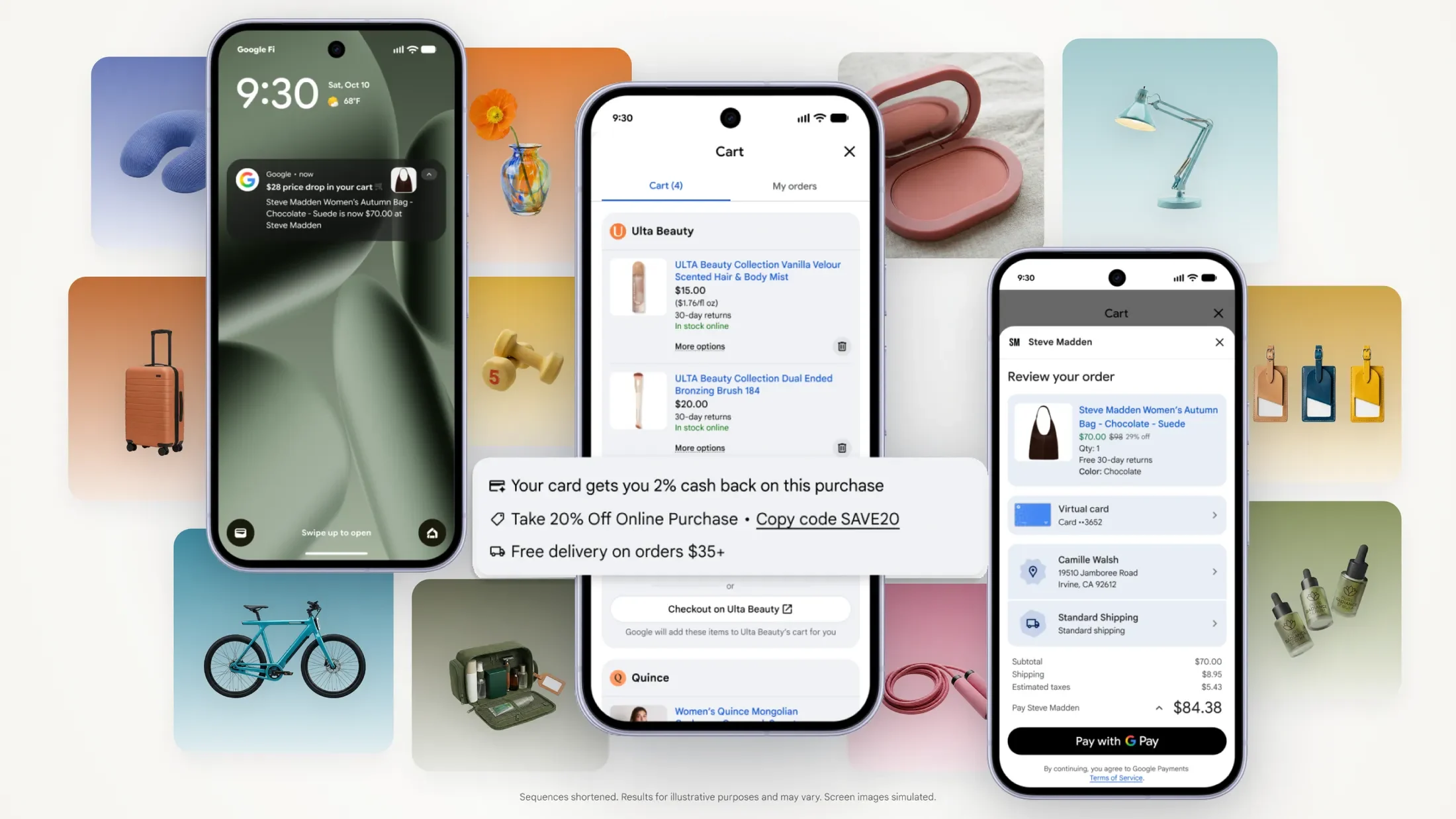
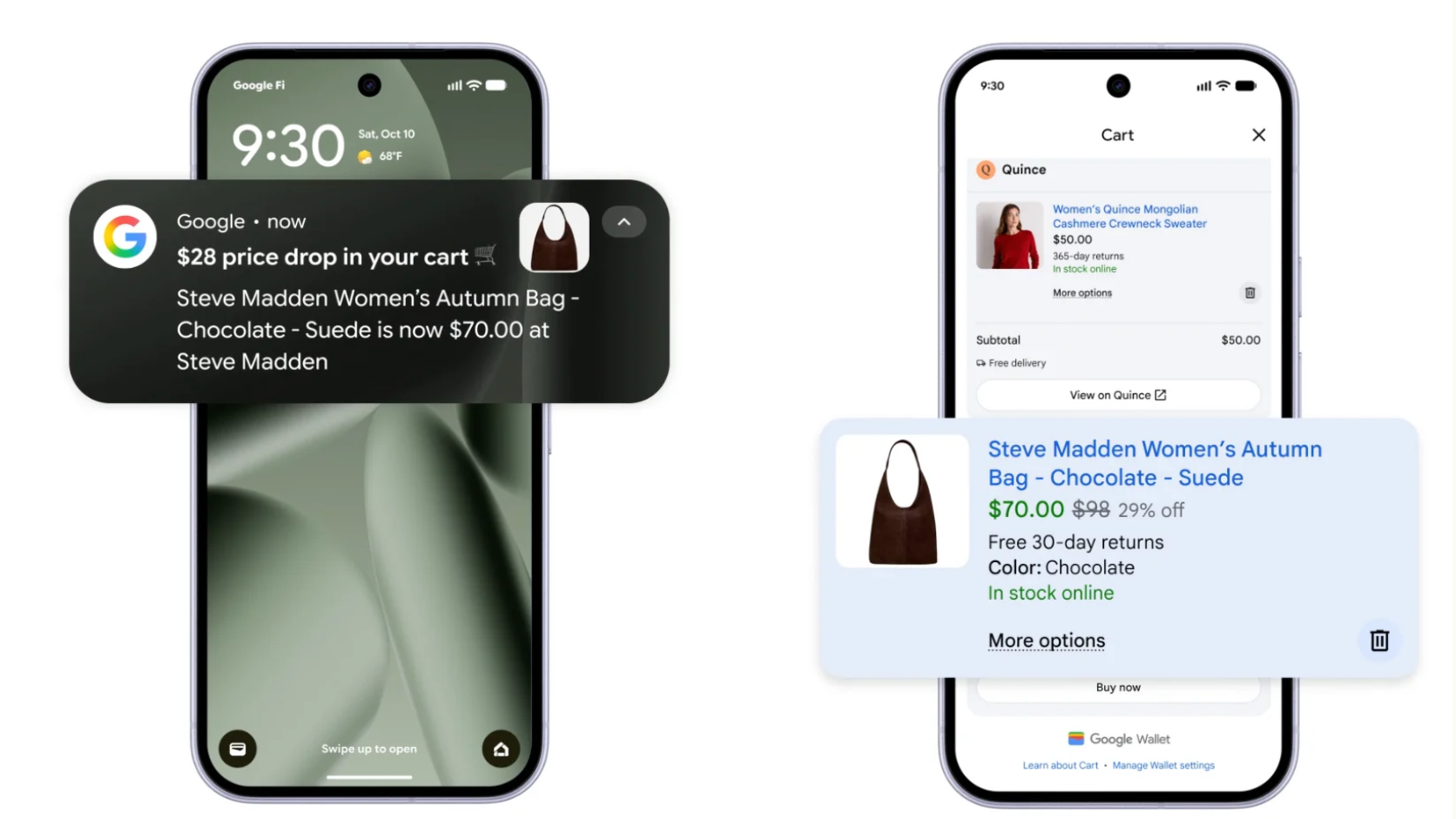
A shopper can save a handbag in AI Mode, a sweater in the Gemini app and a lipgloss from a third store, and find all three in one cart later. According to Google's launch post, the cart tracks price drops and restocks using the Shopping Graph's 60 billion-plus listings, suggests which card to pay with based on perks in Google Wallet, and shows promo codes. When they're ready, shoppers can check out with Google Pay "in just a few taps" or transfer the items to the retailer's own cart.
Launch retailers include Nike, Sephora, Target, Ulta Beauty, Walmart, Wayfair and "many Shopify merchants". Either way, Google says, the merchant remains "the seller of record".
Is Universal Cart a déjà vu?
In March 2018, Google launched Shopping Actions. Retailers including Target, Walmart, Ulta Beauty, Costco and Home Depot could sell across Google Search, Google Express and the Google Assistant, and shoppers got "a universal cart whether they're shopping on mobile, desktop or via a voice-powered device", as TechCrunch reported at the time. Google took a cut of every sale.
A year later, Google folded Google Express into a redesigned Google Shopping, with a universal cart, checkout through the shopper's Google account, and plans to bring shopping to Google Images and YouTube. TechCrunch's verdict: "Google Express wasn't really working."
In 2020 the program, by then called Buy on Google, dropped its commission and added PayPal and Shopify. In 2021 it left France. In September 2023 it closed in the US. Google's explanation: "Buy on Google was a small feature that a very limited number of merchants used, so we're investing in this new buying experience instead."
Why didn't it work?
Google never published numbers, so this is our read. Shoppers kept buying where they always had, on the retailer's site or on Amazon. Retailers had little reason to hand over their checkout, because it meant giving up the upsells, cross-sells and customer data that make a sale worth having. Google kept making the offer cheaper, from a commission to free, and still very few merchants signed up.
What's different this time?
Quite a lot, on Google's side:
- Shopping now starts in AI. Shoppers research products in AI Mode and Gemini, so the cart sits where the shopping happens.
- The retailers are there from day one. Eligible Shopify stores were switched on for checkout in Google by default in September, and major US retailers are part of the launch.
- The plumbing is shared. The cart runs on the Universal Commerce Protocol (UCP), and Amazon, Meta, Microsoft, Salesforce and Stripe joined its Tech Council in April alongside Google, Shopify, Etsy, Target and Wayfair.
- There's no fee, and there's a way out. Google says it has no plans to take a cut of purchases, and shoppers can send their cart to the retailer's site instead of paying in Google.
And not much, on the shopper's side. OpenAI moved ChatGPT's Instant Checkout into retailer apps in March. Walmart's Daniel Danker said conversion inside the chatbot was three times lower than when shoppers clicked through, Modern Retail reported. In a Gartner survey, only 11% of US consumers were willing to let AI make purchase decisions.
Even the roadmap repeats itself. YouTube was on the list in 2019, and it was on the list again when Google previewed Universal Cart in May. It isn't part of the October launch.
Do you think things will change?
Here's our take.
We don't think checkout is where Google wins this time either. Most shoppers will keep paying on the retailer's site, and Google seems to know it, because this time the cart comes with a transfer button.
What has changed is what retailers lose when shoppers skip Google's checkout. Back then, a shopper who ignored Google's checkout clicked through to the retailer's site, and the retailer saw everything: the visit, the cart and the abandoned cart. With Universal Cart, the save happens in Google whatever the shopper does next. Google keeps the list of what people want, from every store, over days or weeks. The retailer sees only the shoppers who make it to the end.
So we see Universal Cart as another attempt by Google to remain the king of data, with retailers more and more at its mercy. Google calls itself "a matchmaker, not a marketplace" and takes nothing from sales today. But marketplaces can take more over time. Amazon's average cut of third-party sellers' revenue passed 50% in 2022 once fees, fulfilment and advertising are counted, by Marketplace Pulse's estimate. And regulators are paying attention: in July, the European Commission fined Google €460 million under the Digital Markets Act for ranking its own services, shopping included, above rivals in Search. Google hasn't announced Universal Cart for the EU.
What does the retailer actually see?
Almost nothing, until the end. eCommerce consultant Brandon Lazovic worked through Google's UCP and Merchant API guides, as reported by PPC Land. Google's Cart API reference says Google "accumulates those items locally" and "does not fire multiple API calls as items are added". The retailer gets one request with every saved item when the shopper presses transfer, and nothing syncs in this first release.
So a product saved on Monday and transferred on Friday reaches the retailer as a Friday visitor with a full cart. A product saved and never transferred doesn't show up anywhere.
That's the moment most abandoned-cart programs are built on. Baymard Institute puts the average documented cart abandonment rate at 70.22%, and on a retailer's own site, every one of those carts tells it who was interested, in what, at what price. In Universal Cart, Google keeps that. Google's reporting in Merchant Center starts at "Clicks to Buy" and doesn't count saves. Lazovic notes that he read this from the documentation and hasn't run a live transfer.
Is there anything retailers can track?
One thing. The retailer's system builds the link that sends the shopper back to its cart, so it can add a parameter that marks the visit as a Universal Cart transfer. Without one, those shoppers show up as ordinary Google or direct traffic, and there's no way to pick them out later.
Who owns the customer when the shopper pays in Google?
On paper, the retailer. In practice, it's less clear.
When a shopper checks out inside Google, Google runs the page and the retailer processes the order. Google's native checkout guide says the retailer first receives the items and the shopper's city, state and ZIP code. Name, email, phone and full address arrive when the shopper presses pay. Google says retailers "retain full ownership" of their customer relationships and data. But a few things are missing:
- Marketing consent. Google's UCP FAQ says it is "planning a feature that will allow users to explicitly opt-in to marketing communications". Until then, the retailer gets a customer it may not be able to email.
- The retailer's own tracking. For Shopify stores, custom pixels and client-side Google Analytics "aren't supported in the direct checkout experience", Search Engine Land reported.
- The retailer's checkout. Cross-sells, bundles and loyalty sign-up live on the retailer's checkout page. Google shows its own.
Meanwhile the retailer, as merchant of record, carries the returns, refunds, customer service, fraud checks and late deliveries. If a parcel is late, the shopper calls the retailer, even though the experience they remember is Google's. And Google hasn't said whether a cart spanning several stores is paid as one charge or one per store, or how returns work across stores.
What happens to personalisation?
It moves to Google. A retailer's recommendation engine learns from what shoppers browse, save and abandon on its site. In Universal Cart, Google decides when to send a price-drop alert, which promo code to show and which card to suggest, and the retailer's own models never see the session.
Google's next step, listed in Merchant Center as "coming soon", is identity linking: shoppers connect their account with a retailer so member pricing and loyalty benefits apply in Google's checkout. Good for the shopper. For the retailer, it means sharing who the customer is and what they're entitled to, while Google keeps the browsing and the cart.
There's an accuracy risk too. Price alerts run on Google's copy of the retailer's data, and Lazovic flags a suspected, unconfirmed problem: a sale that has ended on the site but still sits in the feed could trigger a "price drop" alert that sends the shopper to a higher price. Keeping feed and site data in line was already good practice. Universal Cart puts any gap in front of the shopper.
Does this matter in Australia yet?
Not yet, but soon. Universal Cart is US-only for now. In June, Google named Australia its first Asia Pacific market for UCP checkout, with Adore Beauty, Bunnings, Kogan, Petbarn and THE ICONIC as launch retailers, ChannelNews reported. Google's Merchant Center integration guide says the setup hub reaches Australia and Canada "early next year". That leaves a few months to decide how to take part.
So what should retailers do now?
- Tag the transfer link. Add a parameter to the link your cart endpoint returns, so Universal Cart shoppers show up in analytics from day one.
- Decide on checkout in Google product by product. Check whether your platform enrolled you by default. Checkout in Google needs three checkout endpoints, real-time stock checks and an eligibility flag on each product, which is off by default. Sending the cart to your site needs only one cart endpoint.
- Make the transfer landing count. A shopper arriving with a full cart is ready to buy. Recognise them, invite them to sign in and show member pricing.
- Keep feed, promotions and site in sync. Price alerts are only as accurate as the data Google holds about you.
- Plan for protocol upkeep. UCP has had two releases this year. Budget for keeping up, or confirm your platform will.
How we think about this at Core dna
Retailers can't stop Google from holding the cart. They can control what Google reads about them, and what happens once a shopper lands on their own site.
Core dna runs content and commerce on one platform, so product pages, promotions and feeds draw on the same product, pricing and stock records, set once across every brand and every location. The retailer's own site is where a transferred cart lands, and where accounts, member pricing and personalisation stay the retailer's. Through the Core dna MCP server, teams can check what agents see against live catalogue data, under the same permissions and audit log as the admin.
Google Universal Cart: FAQ
Summarize with