
Hybrid Headless CMS
Hybrid Headless CMS Built for Content, Commerce, and the Teams Who Run Both
Deliver content to any channel via API, with a visual editor that non-developers can actually use, and ecommerce built into the platform, not connected to it.
Why Companies Are Moving Away From Pure Headless Stacks
Headless architecture solved a real problem. The problem is what comes next: Three vendors, four integration points, multiple points of failure, an engineering team spending more time on plumbing than product.
Client Words

“We needed to control how our products reach practitioners without slowing down growth. Core dna gave us the flexibility to distribute product data across our network while keeping everything centralized.”
- Centralized catalog across practitioner portals
- Headless product data delivery to partner systems
- Access control by practitioner and permissions
- Custom pricing and product visibility by account
- Unified workflows for compliance and updates
- Built to scale across large practitioner networks

What Core dna Delivers

API-First Content Delivery
Content is delivered anywhere via REST and GraphQL APIs. Websites, mobile apps, digital signage, and custom interfaces all consume the same structured content. Core dna is frontend-agnostic.
Visual Editor for Marketing Teams
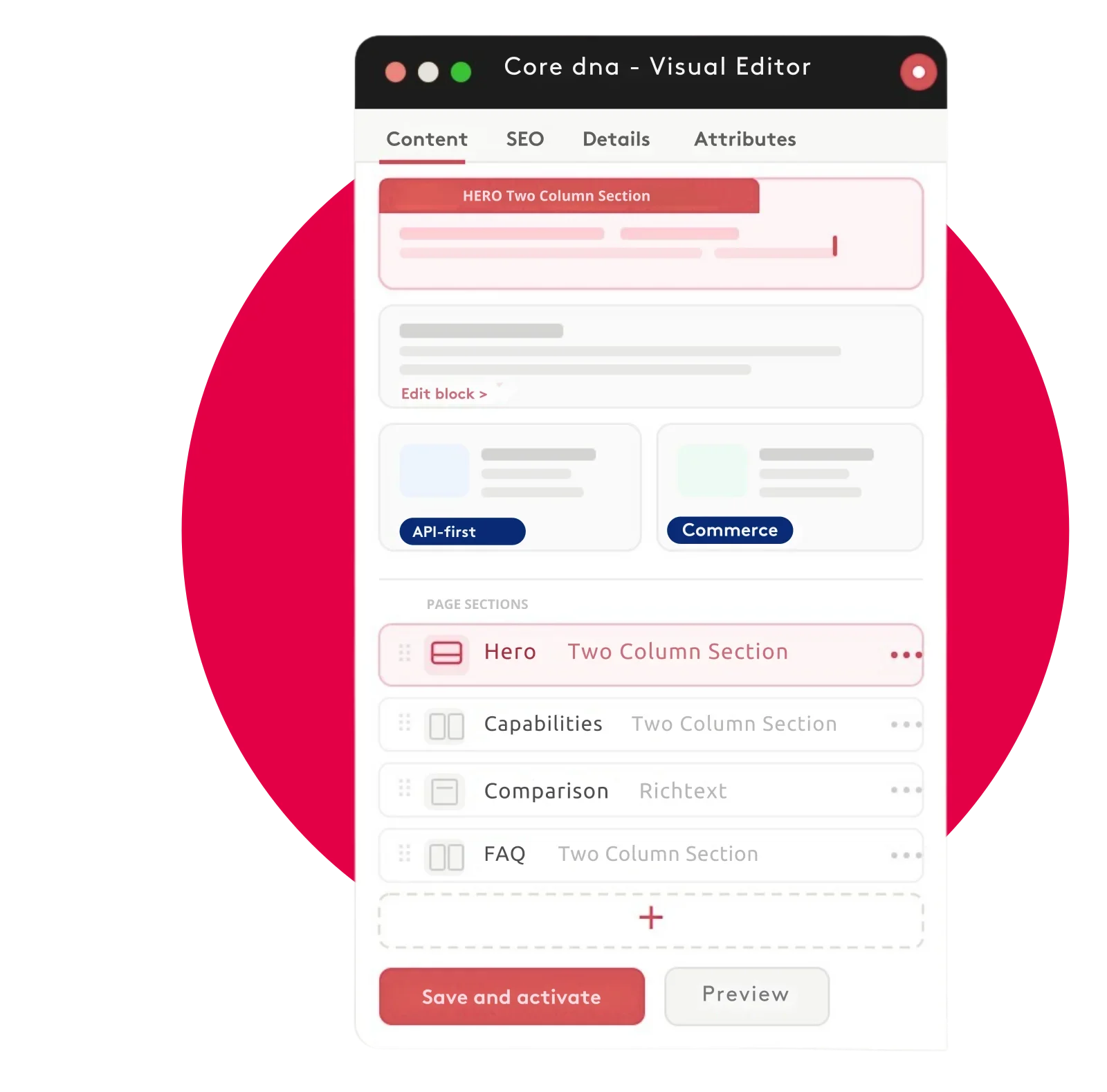
Built-in visual editor that allows content teams to create, update, and publish pages without developer involvement. The visual editor operates on top of the structured content model.

Multi-Site Architecture
Manages multiple sites from a single platform instance. Each site has its own content model, design system, and editorial permissions while sharing a common backend and infrastructure.

Orchestration and Integration Layer
Built-in orchestration layer for connecting third-party systems: ERP platforms, CRM tools, payment gateways, marketing automation, and data platforms.

Managed Infrastructure
Infrastructure, security patching, performance scaling, and platform updates are handled by Core dna. Your engineering team does not own the deployment pipeline or the update schedule.

Commerce & Payments
Define pricing and checkout rules per market from one central product catalog and support multi-currency, multi-payment-gateway, multi-tax-rule across all storefronts.
Hybrid/Headless Approach
Core dna's Hybrid headless CMS preserves that API-first delivery model but adds a structured frontend layer that allows non-developer teams to manage content independently.
- API-first content delivery
- Visual editor included so marketers work independently
- Commerce native to the platform
- Orchestration layer included
- Marketing teams publish independently
- Single managed platform
- Managed by Core dna

Built-In Commerce
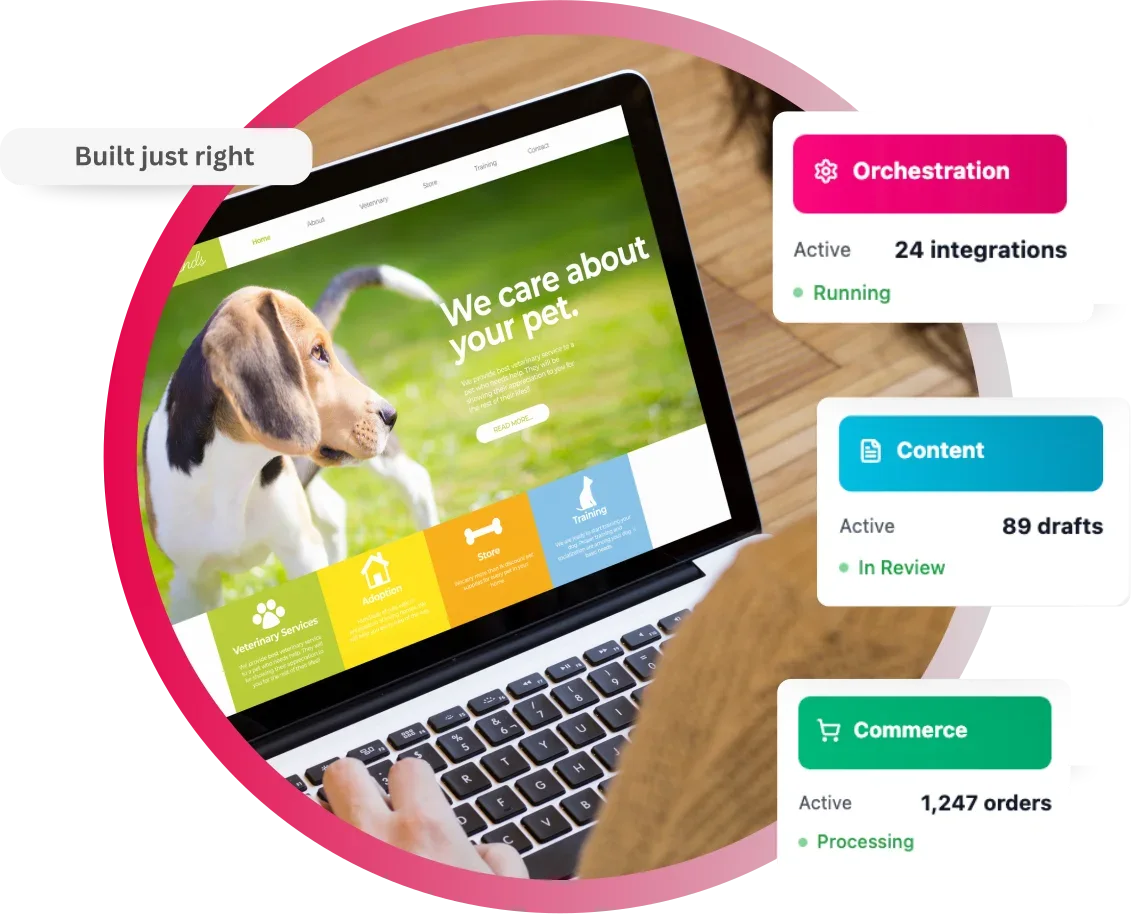
eCommerce capabilities in Core dna are part of the platform, not an integration. Product catalogues, pricing rules, checkout, subscriptions, and order management run in the same environment as your content.
- Product and variant catalogue management
- Customer-specific and contract pricing, for B2B operations
- Subscription billing and one-time purchase support
- Multi-currency and multi-region commerce
- Headless checkout commerce delivered via API like content
What it's like to work with Core dna
Most customers are live in 6–10 weeks. Managed hosting included.
WEEK 1
Discovery & direct access
You work directly with the people who build and maintain the platform, not a reseller or agency. We audit your catalog, ERP, pricing rules, and account structure together.
WEEKS 2–5
Configuration & close collaboration
We partner with your internal team to shape quote workflows, account hierarchies, pricing rules, and payment terms. Full staging environment, your team tests everything before go-live.
WEEKS 5–7
ERP connection & data migration
Your ERP is connected via native webhooks. Product catalog, account data, contract pricing, and tax rules are imported and validated, no manual re-entry.
WEEKS 8–10
Go live — and we stay involved
Controlled launch with your implementation lead on standby. We stay involved as your needs evolve, every update, every challenge, your dedicated team keeps momentum high.
Hybrid Headless CMS Comparison
Core dna vs the alternatives.
Most headless platforms give you API delivery and leave everything else to you, a separate commerce tool, a separate integration layer, a separate visual editor. Core dna puts it all in one place, natively.
| Capability | Core dna | Contentful | Storyblok | Sanity | Builder.io |
|---|---|---|---|---|---|
| API-first content delivery | ✓ Native | ✓ Native | ✓ Native | ✓ Native | Partial |
| Visual editor for non-developers | ✓ Native | ✕ | ✓ | ✕ | ✓ |
| Built-in ecommerce | ✓ Native | ✕ | ✕ | ✕ | ✕ |
| Commerce without a separate platform | ✓ Native | Build it | Build it | Build it | Build it |
| Multi-site from one instance | ✓ Native | Limited | ✓ | Limited | Limited |
| Orchestration / integration layer | ✓ Native | Build it | Build it | Build it | Build it |
| Marketer independence (no dev required) | ✓ Native | ✕ | ✓ | ✕ | Partial |
| Fully managed SaaS (no DevOps) | ✓ Included | Partial | Partial | Partial | Partial |
| No integration overhead between CMS + commerce | ✓ Native | Build it | Build it | Build it | Build it |
API-first content delivery
Core dna✓ Native
Contentful✓ Native
Storyblok✓ Native
Visual editor for non-developers
Core dna✓ Native
Contentful✕
Storyblok✓
Built-in ecommerce
Core dna✓ Native
Contentful✕
Storyblok✕
Commerce without a separate platform
Core dna✓ Native
ContentfulBuild it
StoryblokBuild it
Multi-site from one instance
Core dna✓ Native
ContentfulLimited
Storyblok✓
Orchestration / integration layer
Core dna✓ Native
ContentfulBuild it
StoryblokBuild it
Marketer independence (no dev required)
Core dna✓ Native
Contentful✕
Storyblok✓
Fully managed SaaS (no DevOps)
Core dna✓ Included
ContentfulPartial
StoryblokPartial
No integration overhead between CMS + commerce
Core dna✓ Native
ContentfulBuild it
StoryblokBuild it
Trusted by






Frequently asked questions
A fully headless CMS provides an API for content delivery and no built-in frontend. Developers build the entire presentation layer. A hybrid headless CMS does the same API-first delivery but adds a structured visual editing layer that allows non-developer teams to manage and publish content without writing code.
The difference becomes operationally significant at scale. With a fully headless CMS, every change that affects page layout or structure requires developer time. With a hybrid headless CMS, marketing teams control the content layer independently while developers retain ownership of architecture, integrations, and the API delivery model.
Yes. Core dna is a native hybrid headless CMS, giving you the best of both worlds: the API-first flexibility of headless and the visual, "what-you-see-is-what-you-get" editing of a traditional system.
Our multi-tenant architecture is built to handle an unlimited number of sites, sub-brands, and regional stores from a single dashboard. You can spin up new sites in minutes using shared components while maintaining unique branding and localized logic for every instance.
Yes — this is one of the core design principles of the platform. Core dna includes a visual editor that lets content teams create pages, update copy, manage campaigns, and publish without raising a ticket. Developers set up the content structure and templates; marketers operate within them independently. You don't need to choose between developer control and marketing autonomy
Core dna is a fully managed, Zero-Plugin SaaS platform, meaning we take 100% operational responsibility for your infrastructure. Unlike a WordPress-Shopify hybrid for example, which requires a dedicated team to manage plugin conflicts, manual security patches, and server scaling, Core dna automates these tasks at the engine level.
- Automated Security & Patching: We handle all core upgrades and security patches automatically. Because our features are native rather than third-party plugins, you never have to worry about an update "breaking" your site logic.
FROM THE BLOG
Latest on content & digital experience