B2B eCommerce looks different for every business. Some sell by quote: the buyer asks for a price, a sales rep prepares it, and the accepted quote becomes an order. Others run a hidden catalog, where each account logs in to see only its own products and contract prices.
Distributors may take most orders through EDI or punchout from their customers’ procurement systems. Manufacturers with dealer networks need every dealer selling from the same catalog at their own prices. Many businesses do several of these at once, alongside retail customers paying by card.
A B2B eCommerce platform has to handle all of that: account pricing, quotes, approvals, payment terms and the connection to the ERP that holds your prices and stock. All eight platforms below cover the basics. They differ on quotes, approvals, punchout, EDI and how they connect to your ERP.
Below, we cover how to choose a B2B eCommerce platform, the 8 best platforms of 2026 with their key features and pricing, and the questions to ask each vendor before you sign.
How to choose a B2B eCommerce platform
If we had to narrow it down to the must-haves from the B2B projects we’ve delivered, these are the three steps we’d take before talking to any vendor.
1. Map your ERP and order channels
List what lives in your ERP: price rules, credit limits, stock by warehouse, order history and invoices. Check whether each can be read in real time or only in batches.
Then work out how orders arrive today, and which customers use which channel. A platform that can't show the right price, or can't take orders the way your biggest accounts place them, sends buyers back to the phone. That's what happened at RANDYS Worldwide before it moved to Core dna (see the case study below).
2. Agree on your must-have features
Agree on these with your team before you compare vendors:
- Account pricing, volume pricing and catalogs per customer
- Quotes and approval rules
- Payment by purchase order, ACH or net 30, 60 or 90 terms
- Punchout and EDI for buyers who order from procurement systems
- ERP and CRM sync: prebuilt connector, app, integration platform or custom build
- Buyer portals with orders, invoices, quick order and reorder lists
- How much your team can configure without code, and who runs the platform after launch
- AI agents: what they can change, and whether changes go through your approvals
Use our checklist of 16 B2B eCommerce features to look for in a platform to go deeper on each one.
3. Compare vendors on the same questions
Send every vendor the same questions in the same format, and ask for a working prototype of your real flows: a quote, an order on account and a reorder.
Ask who builds each integration, who maintains it and what it costs each year. Our request for proposal templates help you collect the answers side by side.
8 best B2B eCommerce platforms of 2026
Here are our top 8 picks for the best B2B eCommerce platforms of 2026, and who each one suits best:
- Core dna: mid-market manufacturers, distributors and dealer networks selling B2B and B2C
- Adobe Commerce: B2B groups with subsidiaries and access to Adobe developers
- BigCommerce B2B Edition: wholesalers and manufacturers selling B2B and B2C on SaaS
- Shopify Plus (Shopify B2B): consumer brands adding trade buyers
- Salesforce B2B Commerce (Commerce Cloud): companies already selling on Salesforce
- OroCommerce: distributors and manufacturers with development capacity
- Sana Commerce: suppliers on SAP or Microsoft Dynamics
- commercetools: large enterprises with engineering teams building headless commerce
For each one, we cover what sets it apart, its architecture, its key B2B features, how it handles punchout, EDI and the ERP, and pricing where the vendor publishes it. We read each vendor's product pages, help center and app listings in October 2026. Where we say "app" or "partner", we mean a third-party product, usually with its own subscription, and "not documented" means the vendor's own pages don't mention it; partners may still offer it.
1. Core dna
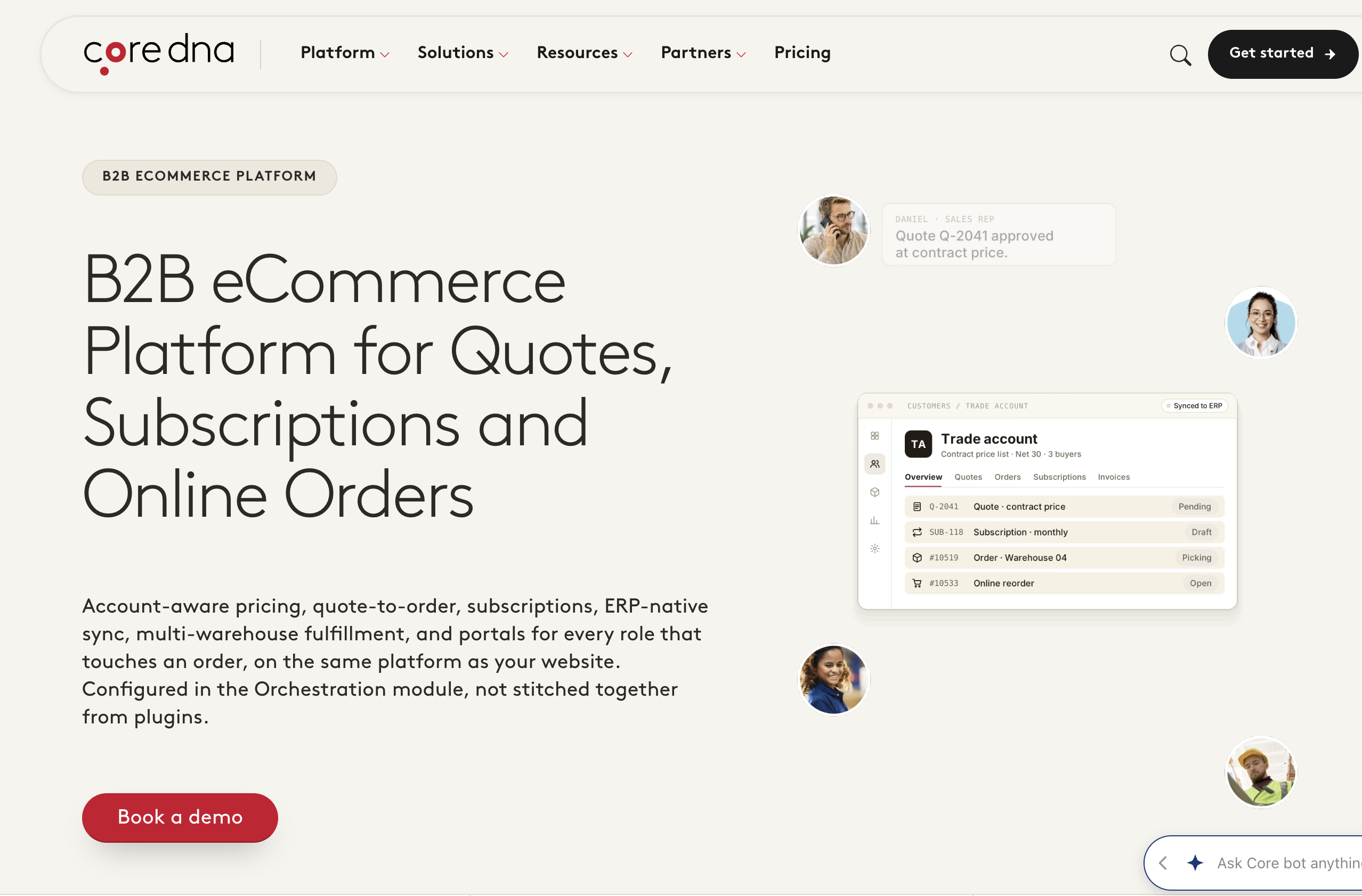 Core dna is a SaaS platform for commerce, content and learning, built for businesses that run many sites, stores, brands or dealer networks from one place. For B2B, the website, catalog, account pricing, quotes, subscriptions and buyer portals run on one platform, and every quote, order, subscription and invoice sits on one customer record.
How you sell is configured in the Orchestration module. Workflows run when a quote, order or customer record changes, scheduled jobs handle renewals, reminders and syncs, and every step carries approvals and an audit log. Your ERP, EDI software and punchout provider connect the same way, so the integrations run inside the platform your team manages.
In 2026, Core dna added orchestration agents and version 2.0 of its MCP server. AI agents such as Claude and ChatGPT can update content, products and prices, and their changes go through the same approvals as your team's. RANDYS Worldwide and V-ZUG run their B2B operations on Core dna (see the case studies below).
Platform architecture
Unified SaaS. Commerce, content and orchestration on one platform and one codebase, run by your team or by AI agents over MCP.
Core dna B2B key features
- Account price lists, contract pricing with effective dates, regional tiers and volume breaks
- Catalogs, prices and payment options set by account, so each buyer sees only their own products
- Quote to order: buyers request quotes in their portal, reps price them with contract rates, and orders over a set value go to a manager
- Payment terms per account: card, net 30 or net 60, prepayment or invoice on dispatch
- Subscriptions billed weekly, monthly, quarterly, annually or on your own cycle
- Portals for buyers, sales reps, store teams and field technicians
- Many sites, stores and brands managed from one platform
- Custom fields, custom entities and workflows configured without code
- AI agents over MCP, off by default, with every change going through approvals
Punchout, EDI and ERP
Your ERP, EDI software and punchout provider connect through Orchestration endpoints and scheduled jobs. Orders post to SAP, NetSuite or Microsoft Dynamics 365, and the Core dna team configures the platform with you and stays on after launch.
Plans and pricing
Structured plans scoped to the sites, stores and volume you run, with no per-seat charges, so adding users never changes the price.
Ask: which integrations your project needs at launch (ERP, EDI, punchout, PIM), who will build them, and what the working prototype in discovery will cover.
See a quote, an order on account and a reorder run on one platform, connected to your ERP.
Account pricing, quotes, subscriptions and buyer portals on one customer record, with your ERP, EDI and punchout connected through Orchestration.
30 minutes. Bring your ERP and order channels.
2. Adobe Commerce
Adobe Commerce, built on Magento, includes its B2B features in the SaaS and PaaS offers. Adobe describes it as built for B2B sales at companies of all sizes, including groups with subsidiaries and businesses selling B2B and B2C together.
Punchout comes from a third-party Marketplace extension, and Adobe's pages don't mention EDI. ERP connections come from Adobe and partner connectors in the Marketplace, so plan for partner or developer time on integrations.
In April 2026, Adobe announced a Commerce MCP server that gives developers real-time access to commerce data, along with B2B components for company accounts, negotiable quotes, requisition lists and purchase order workflows.
Platform architecture
SaaS (Adobe Commerce as a Cloud Service), PaaS (Adobe Commerce on Cloud) or self-hosted.
Adobe Commerce B2B key features
- Company accounts with divisions, users, roles and a parent and subsidiary hierarchy
- Shared catalogs with custom prices per company
- Negotiable quotes from the buyer's cart or the seller's admin
- Purchase order approval rules by role and order
- Payment on account, with credit managed per company
- Requisition lists
Punchout, EDI and ERP
Punchout through a third-party Marketplace extension (cXML and OCI) with its own subscription. EDI isn't documented. Marketplace ERP connectors from Adobe and partners include Microsoft Dynamics 365 and SAP S/4HANA.
Plans and pricing
Adobe doesn't publish prices; every offer goes through a pricing request form. B2B features are included in the SaaS and PaaS offers, and Commerce Intelligence, Payment Services and Order Management are priced as add-ons.
Ask: which B2B features your deployment option includes, and which extensions your punchout, EDI and ERP setup will need.
3. BigCommerce B2B Edition
B2B Edition extends BigCommerce's Enterprise plan, renamed Performance in June 2026, with company accounts, a buyer portal, quotes, credit limits, payment terms and an invoice portal. It suits wholesalers, manufacturers and distributors that want B2B and B2C on one SaaS platform with a large app store.
Punchout and EDI come through apps such as TradeCentric and SPS Commerce, and ERP connections run through third-party apps or integration platforms such as Celigo and Patchworks.
In April 2026, BigCommerce announced new B2B tools, including AI-driven purchase order automation and cascading price lists, with a plan to bring B2B and B2C into one control panel. Its parent company now operates as Commerce, and BigCommerce remains the product name.
Platform architecture
Multi-tenant SaaS.
BigCommerce B2B Edition key features
- Company accounts with custom buyer roles, managed by company admins
- Buyer portal with quotes, invoices and shopping lists
- Price lists assigned per company through customer groups
- Quotes requested from the storefront and revised by reps
- Credit limits, credit hold and payment terms such as net 30
- Approvals for shopping lists
Punchout, EDI and ERP
Punchout through the TradeCentric app and EDI through the SPS Commerce app, each with its own subscription. ERP connections use apps for systems such as Acumatica, NetSuite and Business Central, integration platforms such as Celigo and Patchworks, or the APIs.
Plans and pricing
BigCommerce doesn't publish B2B Edition pricing; it's sold after a demo consultation. For reference, the Performance plan is listed as starting at $1,499 a month, billed annually.
Ask: which apps your setup needs for punchout, EDI and the ERP connection, and what each one costs per year.
4. Shopify Plus (Shopify B2B)
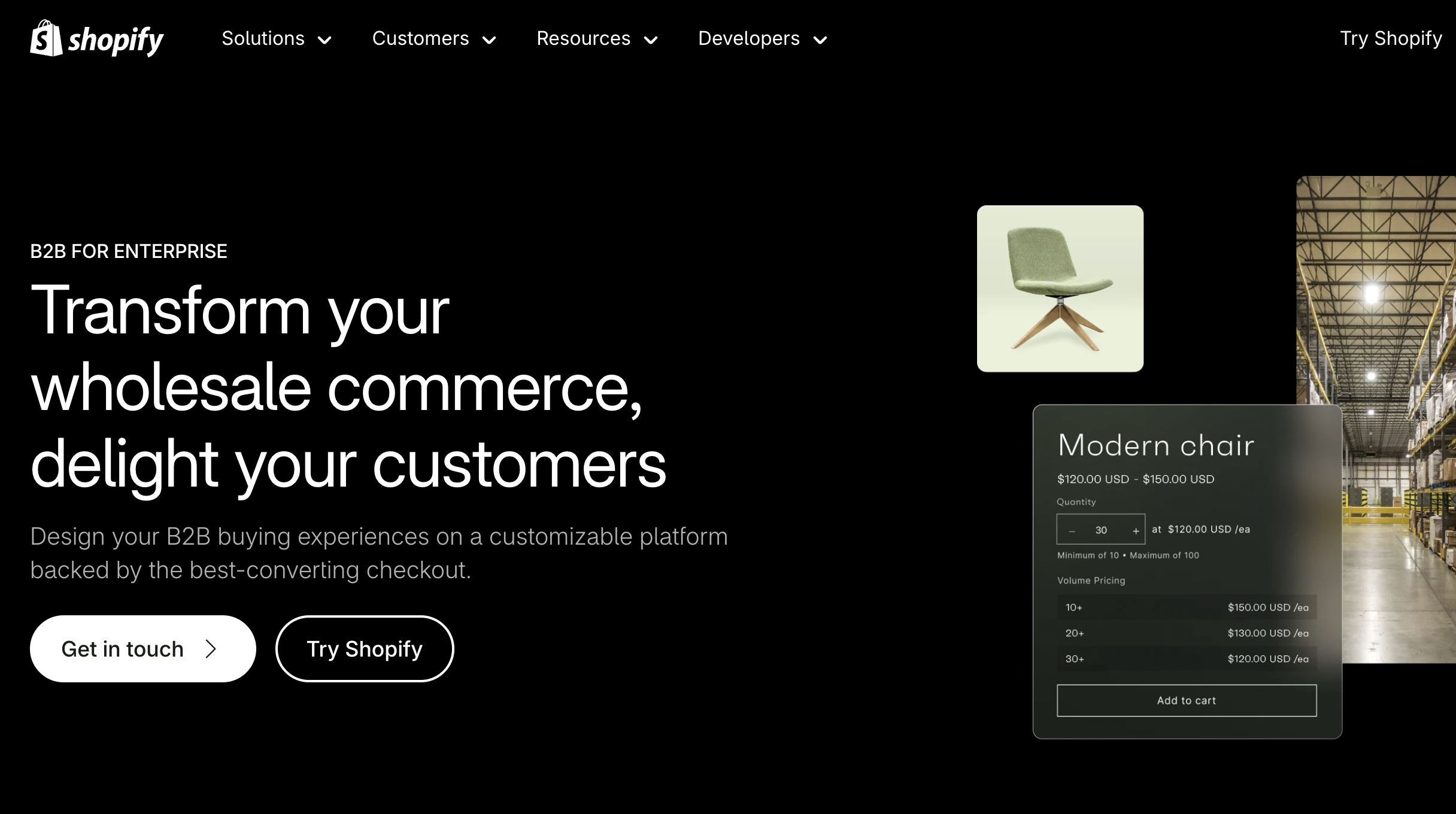
Shopify's B2B features run on the Basic, Grow, Advanced and Plus plans. Since April 2026, the lower plans include company profiles, up to three custom catalogs, volume pricing, quantity rules and payment terms at no extra cost, and Plus adds unlimited catalogs, deposits and partial payments.
It suits brands that sell direct to consumers and add trade buyers to the same store. Request for quote, buyer-side approvals, credit limits, punchout and EDI come from apps, so a B2B setup with quotes or punchout adds app subscriptions.
Platform architecture
Hosted SaaS.
Shopify B2B key features
- Companies with locations and buyer permissions
- Catalogs with quantity rules and volume pricing (up to three below Plus, unlimited on Plus)
- Net payment terms on all B2B plans; deposits and partial payments on Plus
- Draft orders with negotiated prices
- Order review per location, with rule-based review on Plus
- B2B and direct-to-consumer sales from one store
Punchout, EDI and ERP
Punchout through the Punchout Cloud app (cXML and OCI, from $399 a month) and EDI through the SPS Commerce app. ERP connections use App Store integrations for Acumatica, Business Central and NetSuite, integration apps such as Pipe17 and Patchworks, or the B2B APIs.
Plans and pricing
Basic is $39 a month ($29 billed yearly), Grow $105 ($79), Advanced $399 ($299) and Plus from $2,300 a month, in USD. Online card rates run from 2.9% + 30¢ on Basic to 2.25% + 30¢ on Plus, and third-party payment gateways add a fee of 2% down to 0.2%.
Ask: which of your B2B requirements need the Plus plan or an app, and how quotes will work without a built-in request for quote.
5. Salesforce B2B Commerce (Commerce Cloud)
Salesforce B2B Commerce runs inside a Salesforce org, so buyer accounts and price books sit next to your CRM and sales team. It suits companies that already run sales on Salesforce and want commerce and quotes on the same platform.
Request for quote needs Advanced Pricing for Commerce, powered by Revenue Cloud, and ERP connections go through MuleSoft, integration partners or apps.
In June 2026, Salesforce released Agentforce Commerce updates for B2B, including a B2B Buyer Agent that takes procurement orders over WhatsApp and SMS, and cart-to-quote-to-cart negotiation.
Platform architecture
SaaS, running inside a Salesforce org (Enterprise, Unlimited or Developer editions).
Salesforce B2B Commerce key features
- Buyer accounts and buyer groups, with buyer, buyer manager and account switcher permissions
- Price books per store and buyer group
- Request for quote, with Revenue Cloud advanced pricing
- Purchase order or card at checkout, with a PO number field
- Commerce accounts in the same org as your Salesforce CRM
- B2B Buyer Agent for orders over WhatsApp and SMS
Punchout, EDI and ERP
Punchout through TradeCentric's managed package on AppExchange, for Coupa, Jaggaer and SAP Ariba. EDI isn't documented. There's no prebuilt ERP connector; Salesforce points customers to MuleSoft licenses, integration partners or apps.
Plans and pricing
Priced as a percentage of gross merchandise value, meaning the revenue through your storefronts minus tax and shipping. The percentage isn't published. The Growth edition includes 6 storefronts and the Advanced edition 10.
Ask: what the platform will cost at your expected order volume, since pricing scales with GMV, and what MuleSoft or partner work the ERP connection needs.
6. OroCommerce
OroCommerce was built for B2B, with corporate accounts, business units, price lists per account and buyer RFQs in the core. It comes as a free open-source Community Edition or a licensed Enterprise Edition, and runs on OroCloud, a private cloud or on-premise.
It suits mid-market and large distributors and manufacturers with development capacity. Approvals run through configurable workflows, and prebuilt ERP integrations cover distribution ERPs such as Epicor Prophet 21 and JD Edwards.
In April 2026, Oro released OroCommerce 7.0 with OroIQ, a built-in AI layer that answers reporting questions in plain English and creates quotes and orders from typed commands. Oro's documentation also describes an MCP server for the Enterprise Edition back office.
Platform architecture
Open source, deployed on OroCloud, a private cloud or on-premise.
OroCommerce B2B key features
- Corporate accounts with business units, locations and roles
- Price lists per account, business unit or buyer
- Buyer RFQs with online negotiation
- Approvals through configurable workflows
- One payment term per customer
- Multiple sites on one license
Punchout, EDI and ERP
Punchout through partners TradeCentric and Greenwing. EDI isn't documented. Prebuilt ERP integrations cover SAP Business One and ECC, Epicor Prophet 21, JD Edwards, Eclipse, MDS and Sage X3, and integration platforms such as MuleSoft, Boomi and Celigo are supported.
Plans and pricing
The Community Edition is free. Enterprise pricing is based on gross merchandise value, starts with 25 admin users and isn't published, and OroCloud hosting costs depend on your requirements.
Ask: which edition you need, who will host and upgrade it, and who built and maintains the connector for your ERP.
7. Sana Commerce

Sana Commerce Cloud runs the webstore directly on SAP or Microsoft Dynamics data, without third-party connectors or middleware, so prices, credit limits and quotes come from the ERP. It suits suppliers on those ERPs who want the ERP to stay the source of every price.
The ERP list is the trade-off: Sana works with SAP and Microsoft Dynamics only. Sub-accounts and approvals need the Advanced plan, and punchout is a paid add-on.
In June 2026, SAP certified Sana Commerce Cloud for clean core with RISE with SAP, which means it connects to SAP ERP without changing the standard SAP core.
Platform architecture
SaaS.
Sana Commerce B2B key features
- Prices and credit limits read live from SAP or Microsoft Dynamics
- Quotes created in the ERP and converted online
- Sub-accounts with budget approvals on the Advanced plan
- Credit limit checks that warn the buyer, require online payment or block the order
- Up to 3 storefronts on Pro and up to 20 on Advanced
Punchout, EDI and ERP
InstaPunchout is a paid add-on on the Pro and Advanced plans for Jaggaer, Coupa, SAP Ariba and GEP, and handles sales orders only. EDI isn't documented. The ERP has to be SAP or Microsoft Dynamics.
Plans and pricing
Sana doesn't publish prices. The Essential, Pro and Advanced plans are quoted on request, based on your business needs and your SAP or Microsoft Dynamics system, and features such as Sana Pay+ and punchout are paid add-ons on some plans.
Ask: what happens to the webstore if you change ERP, and which of your requirements need the Advanced plan.
8. commercetools

commercetools is a headless, API-first commerce platform for large enterprises, now branded commercetools Sphere. Its B2B features include business units for company and division hierarchies, associate roles with granular permissions, quotes and approval flows, all exposed as APIs.
It suits enterprises with in-house or partner engineering teams who want to build their own storefront and integrations. The storefront is built separately or with the Frontend add-on, and punchout, EDI and ERP connections come through partners and integration platforms. See how Core dna compares with commercetools.
In July 2026, commercetools made its managed Commerce MCP server generally available for AI agents. In June 2026, it announced a B2B intake agent with Mirion Technologies that turns emails, PDFs and spreadsheets into draft quotes and carts.
Platform architecture
Headless, API-first SaaS with REST and GraphQL APIs, hosted in North America, Europe and Australia.
commercetools B2B key features
- Business units for companies and divisions, up to five levels deep
- Associate roles with granular permissions for carts, quotes and orders
- Quote requests, staged quotes and binding quotes that buyers accept, decline or renegotiate
- Approval rules with up to five tiers of approvers
- Prices by customer group, channel and country, with standalone prices per SKU
- Purchase order numbers at checkout, with net terms and credit limits held in custom fields or the ERP
Punchout, EDI and ERP
Punchout through partners such as TradeCentric, which also handles purchase order and invoice automation. EDI isn't documented. None of the documented Connect connectors is an ERP; ERP connections run through marketplace partners (for SAP S/4HANA or NetSuite, for example), integration platforms such as MuleSoft and Boomi, or custom apps hosted on commercetools Connect.
Plans and pricing
commercetools doesn't publish prices. Its pricing page describes an order-based model, and lists add-ons including Advanced B2B APIs and Checkout.
Ask: which B2B features your contract includes, and who will build and run the storefront, punchout and ERP integrations.
Which B2B features are built in, and which are integrations?
Every platform on this list handles accounts and account pricing. The bigger differences sit in the connections around the store: the ERP, EDI and punchout.
A built-in feature is part of the platform you license and is maintained with it. An integration connects the platform to another product, such as an EDI provider or a punchout service, and it has its own owner, its own costs and its own failure points. On every platform here, at least some of your B2B connections will be integrations.
When you compare platforms, four questions show how much of the work sits outside the platform:
- ERP. Is there a prebuilt connector for your ERP, who built it, and does it read prices and stock in real time or in batches?
- EDI and punchout. Do these orders land in the same order record, customer account and reports as online orders?
- Ownership. Who builds each integration, who fixes it when it fails, and what does it cost each year?
- Change. When you add a brand, a warehouse or a price rule, can your team configure it, or does it need a developer or a new app?
What about AI agents?
Adobe, Salesforce, OroCommerce, commercetools and Core dna all released AI agent or MCP features in 2026. For B2B, ask what an agent can change (content, products, prices or orders) and whether its changes go through the same approvals as your team's. Read more on the difference between agentic operations and agentic commerce.
This is our take
In the B2B projects we've delivered, most of the work and most of the problems sit in the connections: ERP pricing, EDI orders and punchout. Compare the cost of building and running them each year alongside the license price.
B2B eCommerce case studies: RANDYS Worldwide and V-ZUG
RANDYS Worldwide
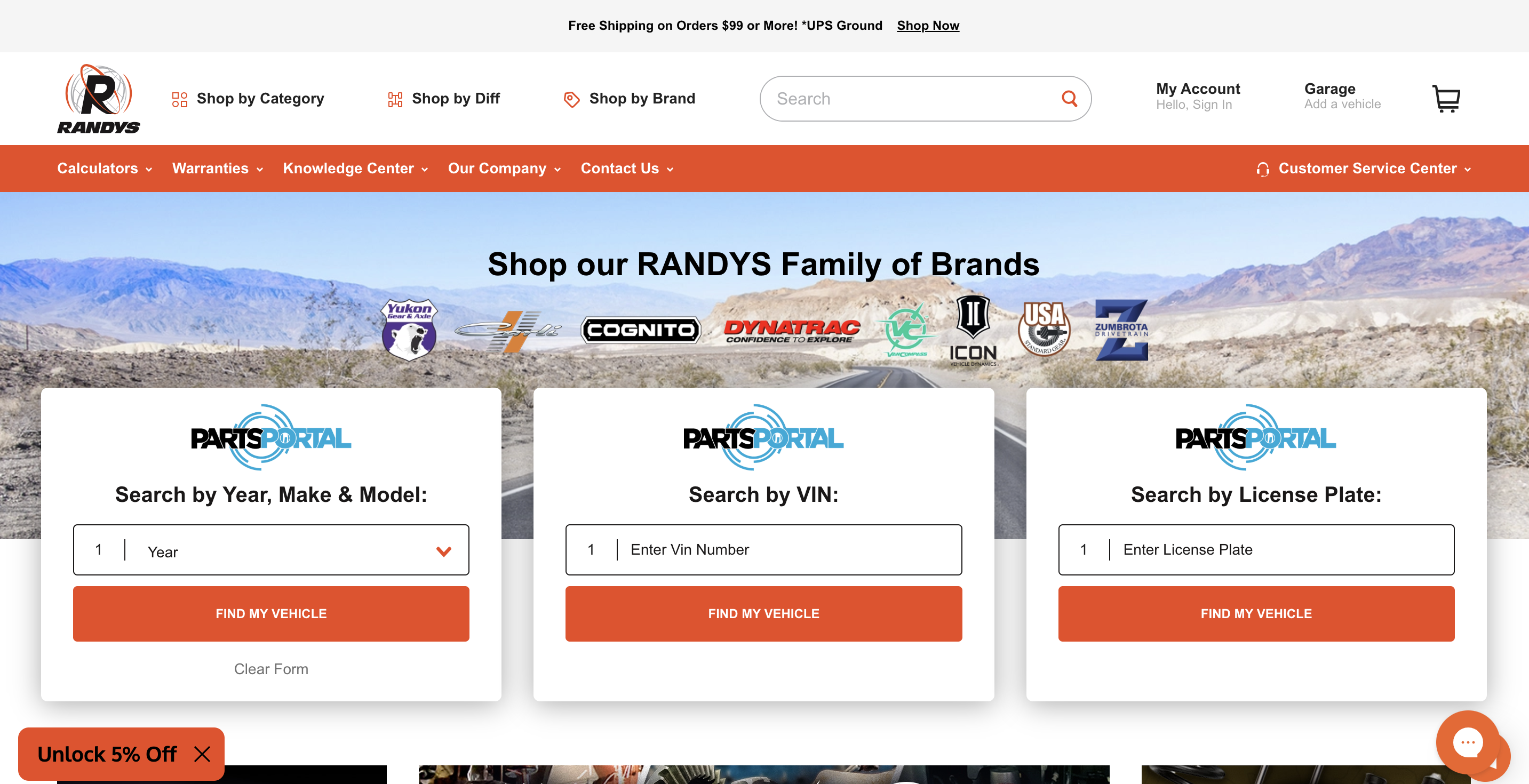
RANDYS Worldwide manufactures and distributes differential parts and has grown through acquisitions. Its previous WordPress site couldn't keep the ERP connection working, so wholesale customers went back to ordering by phone.
On Core dna, RANDYS connected Microsoft Dynamics GP and its product data system, and gave wholesale customers a portal for quotes, invoices, shipment tracking and saved items. Acquired brands moved onto the same platform.
The account page became the site's 9th most viewed page, and online revenue grew from $250K to over $1M. Read the RANDYS Worldwide case study.
V-ZUG

V-ZUG serves three types of buyer from one Core dna portal: its own technicians, independent agents who buy parts at trade prices on account, and a service team ordering for walk-in and phone customers. The login decides prices, payment options and visible products.
Each order looks up or creates the customer in SAP, routes the sales order, reserves stock and hands off to logistics. A sales order that took about 15 minutes by hand now takes a couple of minutes. Read how V-ZUG runs its service operation on Core dna.
For the wider picture, see our guide to B2B eCommerce.
Best B2B eCommerce platforms: FAQ
Most platforms connect to EDI through an EDI provider or a partner app. As of October 2026, none of Adobe Commerce, BigCommerce B2B Edition, Shopify, Salesforce B2B Commerce, OroCommerce, Sana Commerce or Optimizely Configured Commerce documents built-in EDI. What matters is whether EDI orders land in the same order record, customer account and reports as online orders. On Core dna, EDI runs through the supplier's existing EDI software, connected in the Orchestration module.
Yes. Core dna runs B2B and B2C on the same platform, and each customer group gets its own pricing, payment options, and checkout. V-ZUG runs three groups this way: internal technicians on stock transfers, external agents on trade pricing, and a service team selling to end customers at retail.
Summarize with