

Last month I wrote about a slide Satya Tammareddy from OpenAI put up at IRAI in Melbourne. It had generative AI at 40% adoption. My point then was that nobody asked permission before opening the tab. What I skipped was what people do once it’s open, so I went back through the adoption figures published since early 2025: the big surveys, the trackers, and the AI companies’ own usage data.
The number on that slide counts heads, and heads are the wrong unit. Most people are still chatting: asking questions and drafting text. Most of the output comes from a minority who have connected AI to the systems their work runs on. And a high adoption rate tells you very little about which group your organisation is in.
On this page:
No two adoption figures count the same thing
Here are six headline figures and what each one counts as “use”.
| Source | Fieldwork | Headline | What counts as “use” |
|---|---|---|---|
| Pew Research Center | Feb 2026 | 49% of US adults | Answering yes to “Do you ever use” an AI chatbot |
| Gallup | May 2026 | 52% of US workers | Using AI in their role a few times a year or more |
| KPMG and University of Melbourne | Nov 2024 to Jan 2025 | 66% of people in 47 countries | Using AI on a “regular basis”, which includes every few months |
| McKinsey, State of AI 2026 | May to Jun 2026 | Nearly nine in ten respondents | Their organisation regularly uses AI in at least one business function |
| National AI Centre | Feb 2026 | 44% of Australian SMEs | “Some level of AI adoption”, including businesses only planning to |
| US Census Bureau (BTOS) | Sep 2026 | 23.8% of US businesses | Used AI in any business function in the last two weeks |
Change the definition and the number moves. KPMG’s two-thirds shrink to 38% once you count only people using AI weekly or daily. The National AI Centre’s 44% includes firms that only intend to implement AI, and the share of Australian SMEs using it broadly in the same month was 8%.
The wording of the question can move it on its own. When the Census Bureau broadened its business survey question in November 2025, St. Louis Fed economists found that measured US firm adoption “almost doubled” from about 10% to 17%. Even the broader question counts any use in any function. Like every row in that table, it records whether AI is used, and nothing about how much of the work it does.
Once the tab is open, people mostly ask and draft
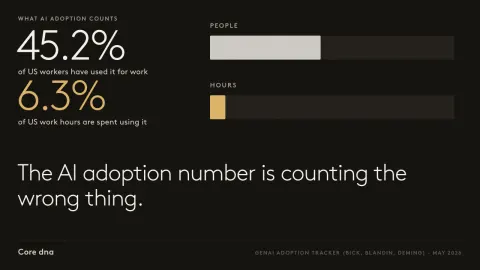
Among US workers who use AI, Gallup found in May 2026 that writing and editing (51%) and search or research (49%) lead, while automation is cited by 16%. The GenAI Adoption Tracker, run by economists Alexander Bick, Adam Blandin, and David Deming, puts it in hours: in May 2026, 45.2% of employed people in its US survey used generative AI for work, and it accounted for 6.3% of their total work hours.
Organisations are scaling the same thing. In McKinsey’s 2026 survey, chatbots are the most widely scaled AI tool, with 47% of respondents saying their organisation is scaling them across the enterprise, and about two in ten saying the same of AI agents.
A minority using agents produces most of the output
In June, OpenAI published data on Codex, its coding agent. Among individual users, fewer than 1% had used it in the previous 28 days. Among people on organisational accounts, 17.3% had. Judged the way adoption is usually judged, that’s a niche tool.
The same paper measures output. Among those organisational users, Codex accounted for 63.3% of the output tokens they generated across Codex and ChatGPT combined. Tokens aren’t value, and a coding agent writes a great many of them, so read that as volume, not worth. By volume, the minority of users working through an agent that sits inside their code, rather than beside it, now generate most of the output.
OpenAI’s Enterprise Signals looks at firms instead of people. It ranks business customers by output tokens per active user, and in June the top 10% of firms generated 8.3 times as many as typical firms, up from 2.6 times in January. Microsoft’s 2026 Work Trend Index surveyed 20,000 people who use AI at work across 10 markets, including Australia, and found that the “Frontier Professionals” who use agents for multi-step workflows are 16% of them.
Neither of those counts share of output. But the most advanced agent users are a minority in Microsoft’s survey, and in OpenAI’s data the gap between the heaviest firms and the rest is widening. Codex and Enterprise Signals are both OpenAI’s own telemetry, and OpenAI has an interest in customers using more of its product.
Counting heads fails in both directions. The adoption rate flatters the majority, because someone who asked a chatbot for a recipe last month counts the same as someone whose agent works in the codebase every day. And it hides the minority, because their work doesn’t show up as more heads. It barely shows up as hours either: the tracker’s 6.3% counts the time people spend using AI, so work an agent does while nobody is watching isn’t in it. The further work moves into connected systems, the less even the better measures can see of it.
Our platform team is one example. In February we embedded AI much more deeply into our engineering process, treating it as part of the infrastructure around the work: the standards, reviews, knowledge, and workflows the team runs on. An adoption survey asking whether my team used AI would have got the same answer the week before as the week after.
Yes, chatting is the on-ramp
The strongest objection is that breadth comes first. Everyone who now runs an agent started by typing questions into a chat window, the argument goes, and depth is arriving: Menlo found that 24% of US AI users now use an AI agent regularly, and that daily AI use rose from 19% to 25% of US adults in a year. On that view, telling a CEO to stop watching adoption means telling them to ignore the precondition for everything they want.
The first part is right. Chatting is how people learn what these tools can and can’t do, and I wouldn’t want anyone to stop. The depth figures are softer than they look, though: daily use is still a count of heads.
And the on-ramp doesn’t lead anywhere by itself. In the McKinsey survey from the table, nearly nine in ten respondents report regular use of AI in at least one business function. In the same survey, 80% say AI has improved their individual productivity, yet 37% attribute at least some EBIT impact to AI, “about the same share as last year”, and the share of AI high performers has “remained flat at about 6 percent”. My read is that individual productivity is what chatting produces, and it doesn’t reach earnings until the work itself changes shape.
The board pack needs three different questions
If I were looking at an adoption slide in a board pack, I’d swap it for three questions about my own organisation:
- What share of the work runs through AI? Measured in hours or output, not logins. Hours miss what agents do unattended, so count output too.
- Of what AI does for your people, how much ends in a chat window and how much lands in a system? An answer someone copies out of a chat window and pastes into another system still depends on that person to carry it.
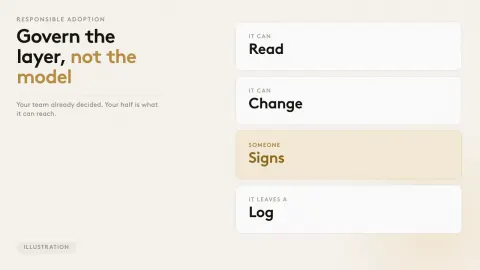
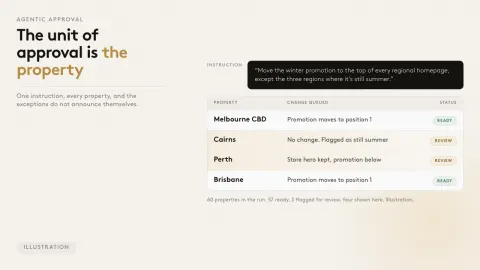
- Which of your systems can AI read and change, and who signs before a change lands? These are the questions I suggested asking of any AI tool last month.
OpenAI’s description of its frontier customers reads like an answer to the third. They “set clear rules for where agents can operate, what information they can access, when they can take actions, and how people review higher-risk decisions”.
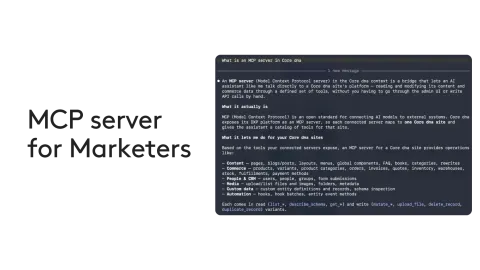
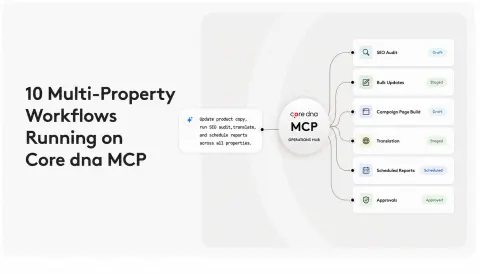
The third question is also where we’ve put our own effort at Core dna, which gives me the same kind of interest I pointed out in OpenAI’s numbers. With MCP, we’re giving customers the ability to work with the content, commerce, and workflows in Core dna directly from the LLMs they already use. We’ve written about the systems side of this in why most enterprise AI stays in the sandbox.
The harder number is how much of your organisation’s work runs through AI that’s connected to the systems where that work happens, and whether that share is growing. We’re still early in measuring that properly ourselves, and I haven’t seen anyone with a clean way to do it yet. But it’s the number I’d want in front of me before approving another round of seats.
Summarize with